


M. Freddy: It is so wonderful to have you here with us, Aaron. You have had an incredible career as a curator and an interdisciplinary artist.
M: For those who are not yet familiar with Aaron’s work, his 2025 solo exhibition Contact Traces was featured by New York Magazine, Whitehot Magazine, and Hyperallergic. He is the Curator of Collections and Exhibitions at the Roswell Museum in New Mexico, and has served on many juries including the New York Foundation for the Arts’ Medical Emergency Grant.
M: Can you tell us about some of the defining moments in your career, and how that has led you to the work you are doing now?
Aaron Wilder: I have the foundation of a self-taught artist and I made my very first painting as an entry for a college scholarship. I got second place and not very much money, but it made me rethink the possibilities of art. I studied art history in college, but I had internalized messaging from childhood that art isn’t a practical vocation, so I pursued work in other fields. On the side, I briefly operated a studio and gallery in downtown Phoenix in 2009. While short-lived, it was fun. Years later, I found myself miserable where I had ended up career-wise and at 30 I made the decision to take a hard left turn and off I went to art school in San Francisco.
M: I love the way your work explores the intersections of art and impact. Can you tell me more about that?
A: What I appreciate most about art is its potential for our imagining of the future we want to live in. I have found that questions are often more valuable than answers. I am interested in art opening space for critical thinking and dialogue. Impact for me moves in many directions: outside impact on me, my impact on others, and impacts between individuals and structures. Some of my work is subtle and some is outright political. There’s plenty of space for divergent artistic strategies and certainly no shortage of issues on which artists engage the world.
M: The intersections of art and impact can be challenging and nuanced. What are some of the artists, artworks, programs, or institutions that are pushing boundaries?
A: I feel that right now almost any art is radical. There’s a total governmental assault on funding for the arts, on free speech, and on the vast majority of lived experiences given form and voice. It floors me that saying anything in support of Palestinians having the right to live is still considered hate speech by many. I think any artist using the resources available to them to subvert repression is even more important than a famous artist, powerful institution, etc. doing the same. I’ve been reading a lot of work by French philosopher Jacques Rancière recently. One quote of his I find empowering: “every situation can be cracked open from the inside, reconfigured in a different regime of perception and signification. To reconfigure the landscape of what can be seen and what can be thought is to alter the field of the possible”.
M: How do you see the future of art and impact? Do you have any advice for readers?
A: There’s impact on art and the art of impact. It’s a continuous circuit. In my opinion, the future is here. Art possesses both the necessity and the capacity to resist, thwart, and deflect external threats to its own and our existence. I recently curated the exhibition “Unstable Language,” which explored the myriad ways artists use their art to understand and respond to harmful narratives and abuses of power. My advice is simply to remember that you have value, your voice matters, and doing something, as small as it may seem, is always better than doing nothing.
M: Do you have any thoughts on who we should interview next and why?
A: Kasia Ozga is a Polish/French/American sculptor and installation artist living in North Carolina whose work was included in the exhibition “Unstable Language” I recently curated. Her practice is very thoughtful and she’s conscious of the lives of human bodies, the lives of the materials with which she works, and the lives of systemic forces. In my view, her work is as beautiful and poetic as it is resonant and urgent. I wasn’t familiar with her work before the show, but I plan to keep an eye on her practice going forward. If interested, here’s a short, recorded conversation I had with her during the exhibition:
M: Fascinating work! Thank you so much for your time today. I will be sure to reach out to Kasia.
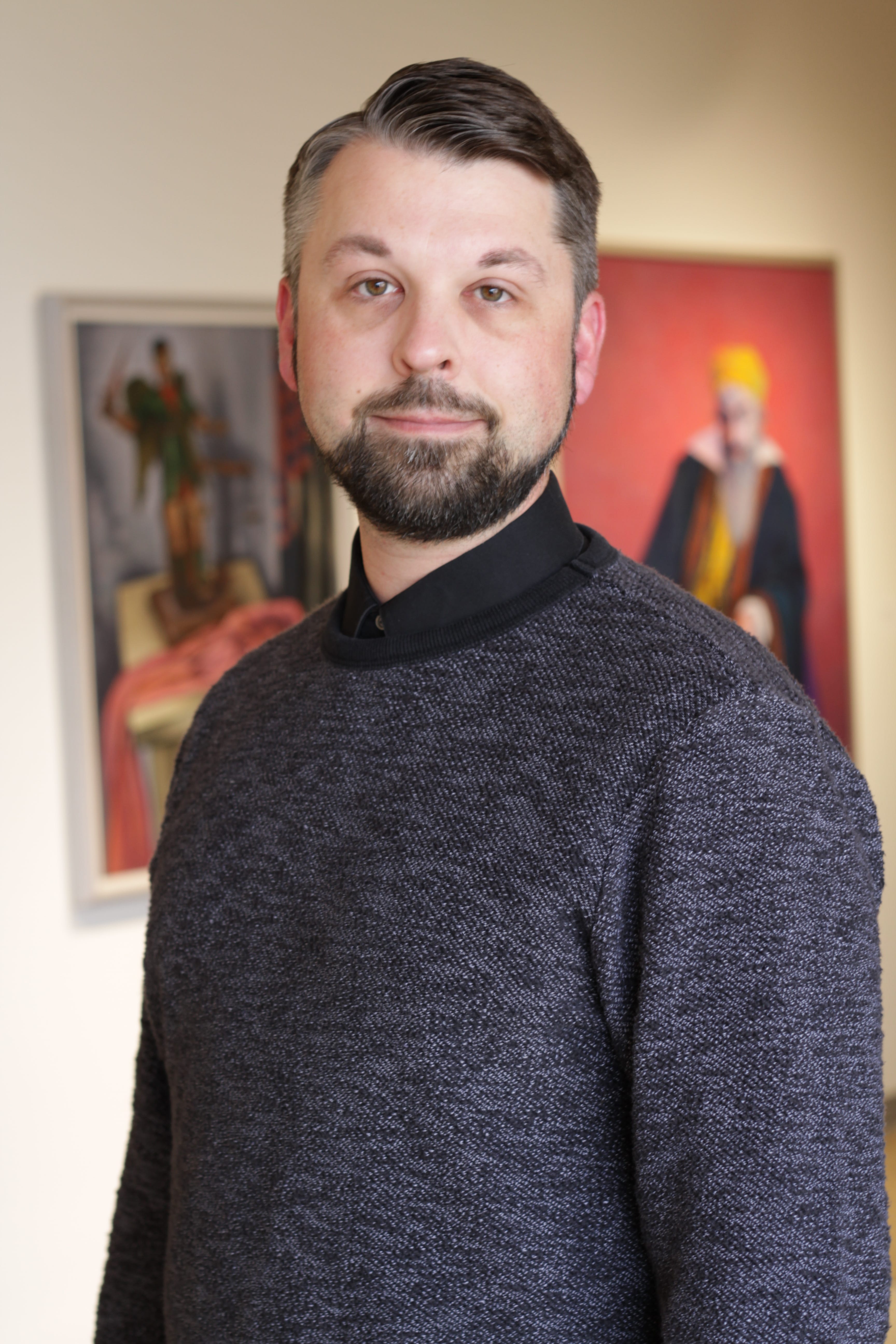
Aaron Wilder is a curator and interdisciplinary artist who blurs boundaries between the analog and the digital, the public and the private, and the unassuming and the instigative. He uses his own experiences and sense of identity as a lens through which he explores the introspective and social processes of contemporary culture. Through an analytical deconstruction of these processes, his artistic approach is akin to that of an anthropologist, sociologist, and psychologist combined. Originally from Arizona, Wilder has also lived in Chicago, Los Angeles, San Francisco, Washington, DC, and France and currently resides in Roswell, New Mexico. With the experience of being a self-taught artist since 2002, Wilder received his Master of Fine Arts degree from the San Francisco Art Institute in 2017. He has exhibited his art extensively across the United States. Wilder became an artist member of Amos Eno Gallery in New York in 2020.